 Es PosibleEs Posible
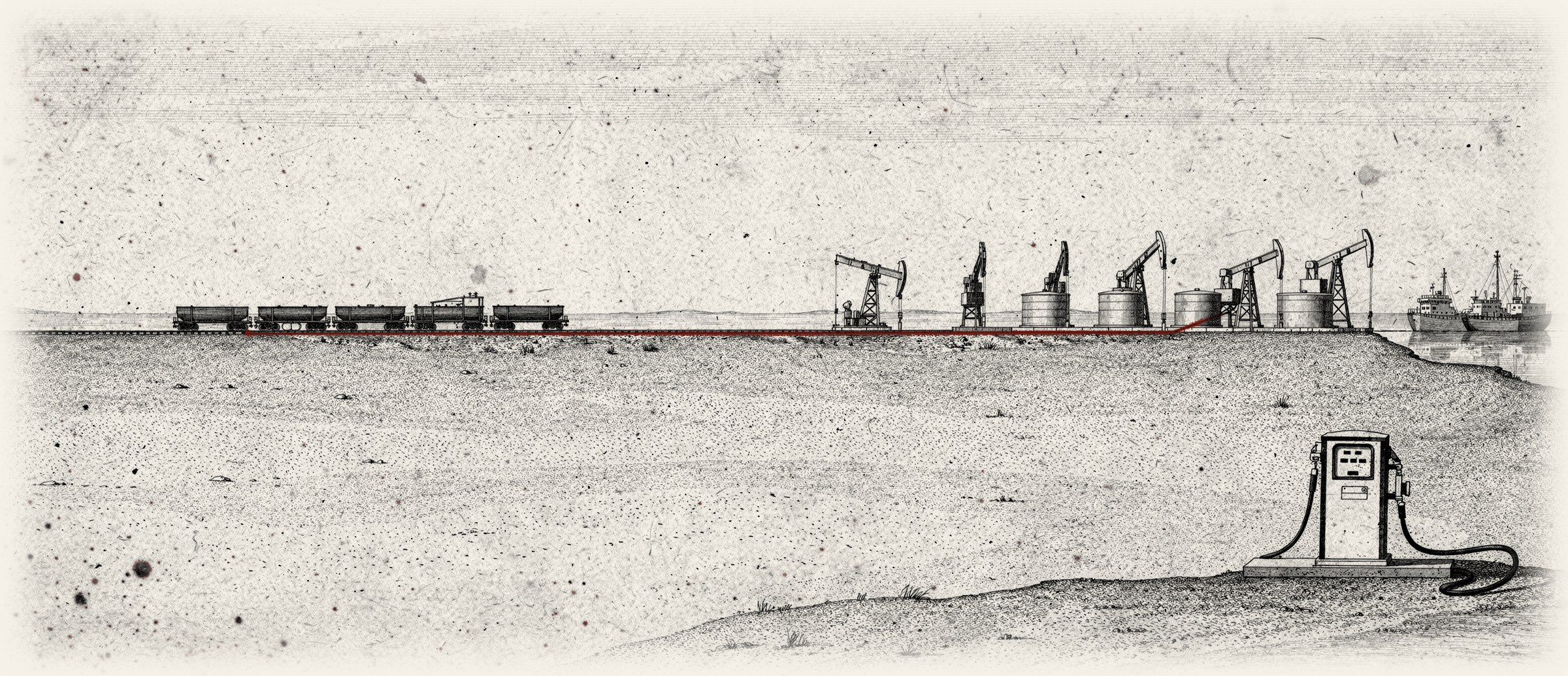
The war explains 96 of every 100 cents of the increase. Mexican fuel theft moves something else: more than $7 billion in suspicious activity through the U.S. financial system.
The gallon taken apart, the Permian theft, the route from Houston to Tampico, the names Treasury has already sanctioned and the companies Washington blocks and Mexico's tax agency does not see.
There is an idea going around: that Mexican fuel theft, huachicol, is driving up gas prices in the United States.
It isn't. Iran is.
But huachicol does something that weighs more in Washington than the price of a gallon. It uses Texas terminals as a warehouse and U.S. banks as a laundromat.
How much huachicol fits in your gallon?
And how much cartel money fits in a Texas bank?
Move the volume of illegal fuel and pick a scenario. The scale calculates how many cents it adds to each U.S. gallon and compares it with what the barrel added since the war began.
Our own calculation, an educational tool. Assumptions: world demand of 104 million barrels per day, combined short-run elasticity of 0.12, crude at $125.59 (Brent, average for the week ending October 16, EIA). In the realistic scenario, illegal fuel replaces imports Mexico would make anyway; only the demand created by its 10% discount counts as new, with an elasticity of 0.3. Starting point: 152,000 barrels per day, the Mexican government's figure for 2025.
Two weeks ago Fortune reported that oil theft is rising in the Permian, the largest oil basin in the United States, stretching across West Texas and southeastern New Mexico.
Fortune's explanation is simple. Since the war with Iran began, crude is worth more. And what is worth more gets stolen more.
The Dallas Fed Energy Survey put numbers on it. Among oil firms focused on the Permian, 46% said theft affected their operations in the past year. In other basins, 14%. Among those affected, 47% described the most common theft as targeted and organized. But 84% rated the financial impact as low. And on the trend, almost half said theft was unchanged; one in three said it rose slightly.
Howard County Sheriff Stan Parker told Texas Public Radio that his area sees "probably over 1,000, 1,500 barrels of oil reported stolen every month." And he named the problem: "Our problem is we don't know who's supposed to be there and who's not."
In Mexico the story was read differently: huachicol is setting off prices in the United States. That is where the question now going around social media came from. Is Mexican fuel theft making gasoline more expensive on the American side?
To answer it you have to separate three things that go by the same name.
One, physical huachicol. The illegal tap on a Pemex pipeline. Gasoline, diesel or crude is stolen, stored in tanks and sold.
Two, fiscal huachicol. Fuel bought legally in the United States that enters Mexico declared as lubricant, additive or petrochemical. The goal is not to steal the fuel. It is to avoid the IEPS, the special excise tax Mexico charges on every liter.
Three, crude theft in Texas. The Permian kind. Thieves with tanker trucks at the wellhead, at night.
The three get mixed up in the headlines. Not in the numbers.
The week of February 23, a gallon of regular gasoline averaged $2.94 in the United States. On February 28, the United States and Israel began bombing Iran.
The gallon peaked the week of May 11 at $4.50. The week of October 19 it was still at $4.28. Diesel, at $6.28. Those are figures from the Energy Information Administration, the EIA.
Now the barrel. Brent was worth about $71 the week before the war. In the week ending October 16 it averaged $125.59. That is $54 more per barrel. A barrel holds 42 gallons. Divide, and you get $1.29 per gallon, from crude alone.
The gallon rose $1.35. The barrel explains $1.29. Of every dollar of the increase, 96 cents are oil. The rest, and then some, comes from refining margins, which also rose with the war.
That is not my opinion. In the Dallas Fed survey, an executive at a producing company wrote: "Producers are not seeing all the benefits of the increased crude oil and gasoline prices; refiners are reaping the majority of those benefits." Another was blunter: "I don't quite understand why the price is high at the pump. The U.S. has plenty of supply."
So why does it go up, if the United States already has Venezuela's oil?
Because the price of oil does not depend on who owns the barrel. There is one world market, and that is where the price is set for everyone. Think of it as one big pool everyone draws from. At the end of 2025, 21.6 million barrels a day moved through the Strait of Hormuz. In the second quarter of 2026, with the war, 4.9 million did, according to the EIA. The pool lost almost 17 million barrels a day. When water runs short, the price goes up for everyone, including whoever has a well of their own.
Venezuela cannot fill that hole. It produces about 1.25 million barrels a day, according to U.S. energy officials and PDVSA. Even if all of it went to the United States, it would be less than a thirteenth of what stopped coming out of Hormuz. What actually reaches U.S. refineries, a little over 500,000 barrels a day, equals 3% of the shortfall.
And most of that oil was already being sold before the war. It is not a new barrel replacing the one that was lost. It is also heavy crude: to make it flow, the United States sends Venezuela more than 100,000 barrels a day of naphtha.
And nobody sells cheap when someone abroad pays more. The Texas producer and whoever sells Venezuelan crude charge the world price. If a barrel were worth less in Houston than in Europe or Asia, it would go to Europe or Asia. Having oil nearby gives you supply. It does not give you price.
And huachicol? Run the numbers on the scale above. Mexico's government estimates that 8.8 billion liters with inconsistencies moved through its market in 2025. That is about 152,000 barrels a day. In the realistic scenario, that fuel replaces imports Mexico would make anyway, and its effect on the U.S. price does not reach half a cent per gallon. Even in an impossible scenario, where every barrel was new demand, it stays at a few cents.
And Permian theft, not even that: stolen crude is resold into the same market. It does not leave the supply. It changes owners.
Verdict on the gallon: Iran raises it. Huachicol doesn't.
But stopping there means keeping half the story. Because huachicol is not measured in cents per gallon. It is measured in another currency.